
Torsion & Extension Springs
Garage Door Spring Replacement
A broken garage door spring is one of the most common — and most dangerous — garage door problems. ODST Overhead Doors replaces torsion and extension springs for homeowners throughout Northwest Arkansas and Northeast Oklahoma.
Garage Door Spring Replacement in NWA & Northeast Oklahoma
Garage door springs do the heavy lifting every time your door moves. They counterbalance the weight of the door so the opener and manual operation both work smoothly. When a spring breaks, the door typically becomes inoperable — and attempting to force it can cause additional damage to the cables, tracks, and opener.
ODST replaces broken and worn springs for homeowners in Bentonville, Rogers, Springdale, Fayetteville, Bella Vista, and Centerton across Northwest Arkansas, and throughout Jay, Grove, Afton, Tahlequah, Tulsa, and Broken Arrow in Northeast Oklahoma.
If your door has other damage beyond the spring — bent tracks, frayed cables, or opener issues — see our garage door repair page for a full breakdown of what we fix.
What's Included
- Inspection of spring, cables, and hardware
- Torsion or extension spring replacement
- Both springs replaced when applicable
- Cable and drum inspection
- Door balance test after replacement
- Safety check on opener and sensors
- Post-service walkthrough
Signs You Need Garage Door Spring Replacement
Springs can fail gradually or all at once. These are the most common signs that a broken or failing spring is the problem.
Door Feels Unusually Heavy
Springs counterbalance the weight of the door. When a spring fails, the door loses that counterbalance and becomes difficult or impossible to lift manually.
Door Won't Open
A completely broken spring means the opener has nothing to work with. The opener may run, but the door stays on the ground — or opens only slightly before stopping.
Door Only Opens a Few Inches
Most garage door openers have a safety feature that stops the door if it detects excessive resistance. A broken or weakened spring can trigger this, leaving the door partially open.
Loud Bang from the Garage
A torsion spring breaking under tension makes a sharp, loud noise that sounds like a firecracker or a car backfiring. If you heard it and now the door won't work, the spring is likely broken.
Visible Gap in the Spring
A broken torsion spring will have a visible separation — a gap where the coils pulled apart. This is one of the clearest signs that the spring has failed and needs immediate replacement.
Uneven Door Movement
When one spring in a two-spring system breaks, the door may lift unevenly — one side higher than the other. This puts stress on the tracks, cables, and opener and should be addressed quickly.
Not sure if the spring is the problem? Our garage door repair page covers other common issues that can cause similar symptoms.
Why Garage Door Springs Fail
Spring failure is rarely sudden without cause. Understanding why springs fail helps homeowners know what to expect and how to extend the life of a new spring.
01
Age and Normal Wear
Garage door springs are rated for a specific number of cycles — typically 10,000 to 20,000. At one to two cycles per day, that's roughly 7 to 14 years before a spring reaches the end of its rated life. Most springs fail simply because they've completed their designed lifespan.
02
High-Cycle Usage
Homes with multiple drivers, attached garages used as primary entries, or commercial properties that open and close doors many times per day will wear through springs faster than the average household.
03
Rust and Corrosion
Rust weakens the coils and increases friction as the spring moves. Humidity, temperature swings, and lack of lubrication accelerate corrosion — particularly in garages that aren't climate-controlled.
04
Lack of Maintenance
Springs that are never lubricated wear faster. A basic maintenance schedule — including lubrication and tension checks — extends spring life and catches wear before it becomes a failure.
05
Extreme Weather
Cold temperatures make metal more brittle and can cause springs to snap under load. Northwest Arkansas and Northeast Oklahoma both see significant temperature swings, which contributes to spring wear over time.
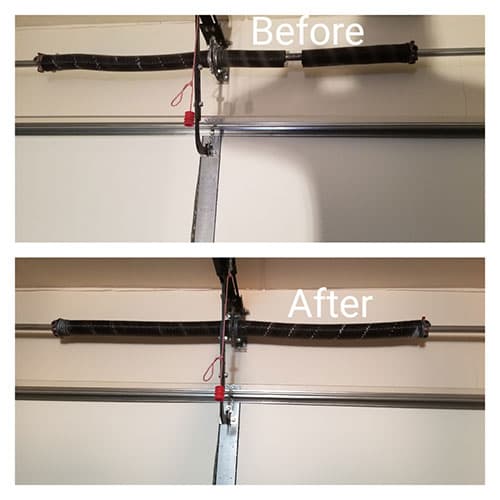
Before & After
Spring Replacement Results
A properly replaced spring restores full balance and function to the door — and removes the safety risk of a failed or failing spring.
Torsion Springs vs Extension Springs
Most residential garage doors use one of two spring types. The right replacement depends on what your door already has and how it's configured.
Torsion Springs
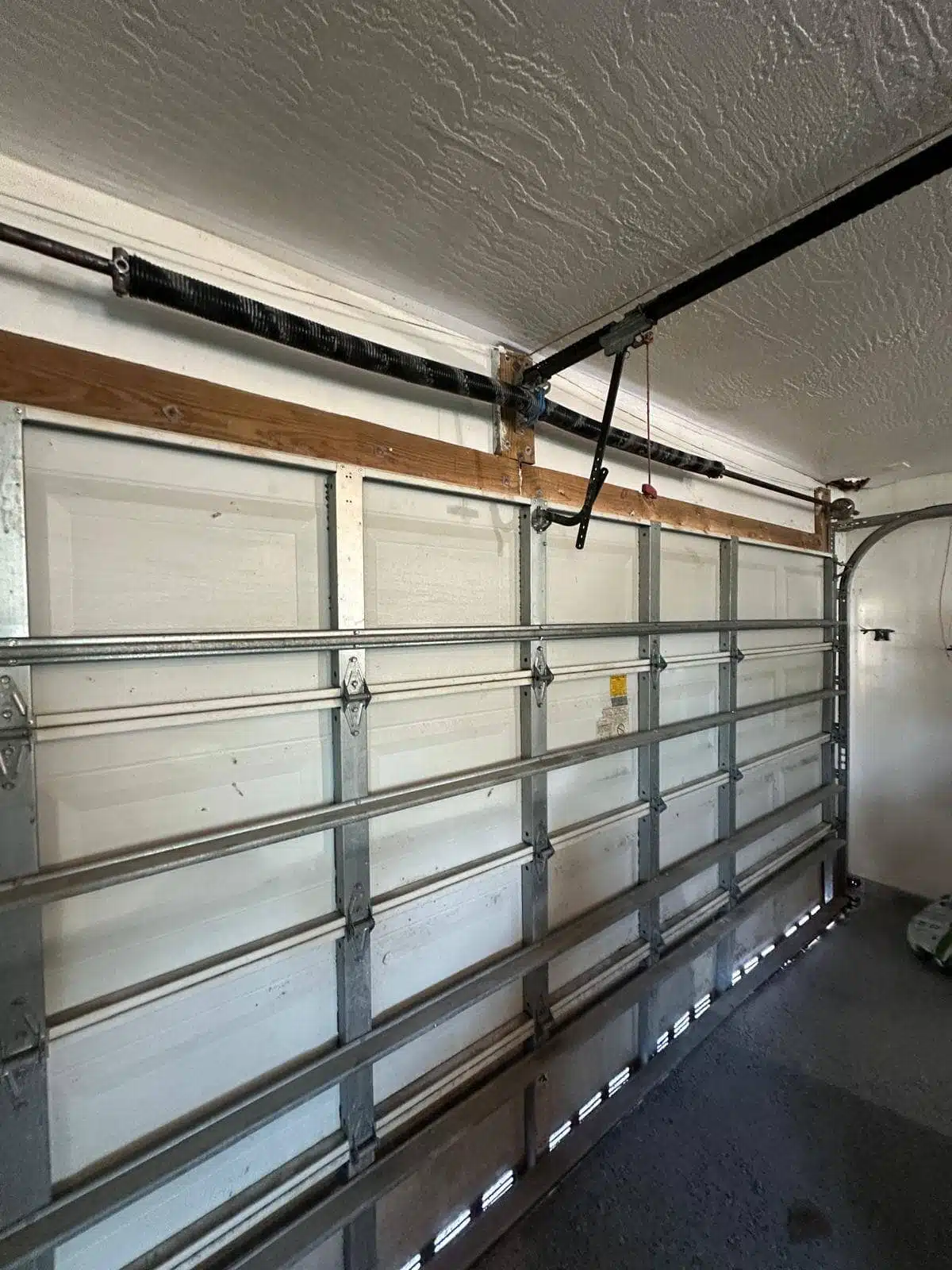
Torsion springs mount on a metal shaft directly above the garage door opening. As the door closes, the spring winds up and stores energy. When the door opens, that energy unwinds and lifts the door.
- Standard on most newer homes
- Generally last longer than extension springs
- One or two springs depending on door weight
- More controlled failure — less whipping hazard
- Preferred for heavier and wider doors
Extension Springs
Extension springs run along the horizontal tracks on either side of the door. They stretch and contract as the door moves, providing the counterbalance through tension rather than torque.
- Common in older homes and smaller garages
- Run parallel to the tracks on each side
- Two springs — one on each side
- Safety cables recommended to contain broken springs
- Both springs should be replaced together
Why Spring Replacement Is Dangerous
Garage door springs store an enormous amount of energy. A standard torsion spring on a residential door can be under several hundred pounds of force when fully wound. When that tension releases unexpectedly — during removal or installation — the spring can snap, fly off the shaft, or strike the person working on it with enough force to cause severe injury.
This isn't a task where the risk is hypothetical. Spring-related injuries are among the most common serious injuries in garage door work. The tools, technique, and experience required to safely remove a wound spring and install a new one at the correct tension are not something most homeowners have access to.
ODST technicians are trained specifically in spring work. If your spring is broken, the safest thing to do is stop using the door and call for professional replacement.
Do Not Attempt This Repair Yourself
Garage door spring replacement is one of the most injury-prone home repairs. The tension stored in a torsion spring can cause the spring to act like a projectile if it releases during removal.
If your spring is broken, stop operating the door and contact ODST for a professional replacement.
Call 918-801-8993Garage Door Spring Replacement Service Areas
ODST replaces broken and worn garage door springs for homeowners across Northwest Arkansas and Northeast Oklahoma.
Northwest Arkansas
Why Homeowners Choose ODST for Spring Replacement
Spring replacement is not a job where cutting corners pays off. ODST uses properly rated springs, sets the correct tension for your door's weight, and tests the door before leaving. When you call ODST for a broken spring in Bentonville, Rogers, Jay, or anywhere in our service area, you get a professional who does the job right.
- Owner-Operated — Direct communication and personal accountability on every job.
- Licensed & Bonded — Fully covered for residential and commercial spring work.
- Local Company — Based in the region and familiar with local homes and door types.
- Correct Spring Sizing — We use properly rated springs for your door's weight — not whatever's cheapest.
- Full Inspection Included — Every spring job includes a check of the cables, drums, and balance.
- Honest Communication — If something else needs attention, we'll tell you before we start.
Garage Door Spring Replacement FAQ
Common questions from homeowners about broken garage door springs and spring replacement in Northwest Arkansas and Northeast Oklahoma.
Can I replace a garage door spring myself?
Garage door springs are under extreme tension — enough to cause serious injury if they release unexpectedly during removal or installation. Spring replacement is one of the few garage door tasks we strongly recommend leaving to a trained professional.
How long does spring replacement take?
Most spring replacements are completed in one to two hours. If additional hardware such as cables or drums needs attention at the same time, the job may take slightly longer.
Should I replace both springs at the same time?
Yes — if your door has two springs and one breaks, the other is likely near the end of its life as well. Replacing both at the same time saves a second service call and keeps the door operating evenly.
What's the difference between torsion springs and extension springs?
Torsion springs mount horizontally above the door opening and work by twisting. Extension springs run along the sides of the door and work by stretching. Torsion springs are more common in newer installations and tend to last longer. ODST replaces both types.
How do I know if it's a spring problem or an opener problem?
Disconnect the opener and try to lift the door manually. If the door is extremely heavy and won't stay up on its own, the spring is likely broken. If the door lifts easily by hand but the opener won't move it, the issue is probably the opener. ODST can diagnose either.
Do you replace garage door springs in Northeast Oklahoma?
Yes. ODST replaces torsion and extension springs for homeowners throughout Northeast Oklahoma, including Jay, Grove, Afton, Langley, Tahlequah, Locust Grove, Pryor, Tulsa, and Broken Arrow.
Can a broken spring damage other parts of the door?
Yes. Operating a door with a broken spring puts abnormal stress on the opener motor, cables, drums, and tracks. Continuing to use a door with a broken spring often turns a single repair into a more expensive one.
Broken Garage Door Spring?
Serving Northwest Arkansas and Northeast Oklahoma. Call or request a quote — don't force a door with a broken spring.